What is this group all about?
Coast and Shelf Research Group (CSRG) The Coast and Shelf Research Group focuses on the sedimentary processes and products of modern and ancient coastal to shelfal environments developing on Earth and other planetary bodies, including ocean, sea, and lake nearshore areas. This group aims to bring together the community of sedimentologists with a focus on coastal, shallow-marine and shelfal environments, as well as to promote exchanges and collaborations with other experts (e.g., engineers, archeologists) focusing on similar depositional environments. The CSRG welcomes anyone who is interested in field-, lab- and/or computer-based sedimentology, geomorphology, geobiology, coastal and infrastructure management, paleoclimate, paleoceanography and related topics focusing on coast to shelf settings.
Are you interested in participating in CSRG events, or are you keen on co-chairing/assisting with the organization of workshops or courses?

Why join this group? - Networking opportunities within the Coast and Shelf Sedimentology and wider Sedimentary Geology and Geomorphology communities.
- Opportunities to meet with researchers in-person at annual meetings/key conferences, and virtually at online seminars/discussions.
- Specialized email lists with targeted information about upcoming events, funding and job opportunities, resources, and more.
- LinkedIn Group to facilitate discussions, data, and resource sharing.
- Access to the SEPM membership benefits and community.

Event Calendar
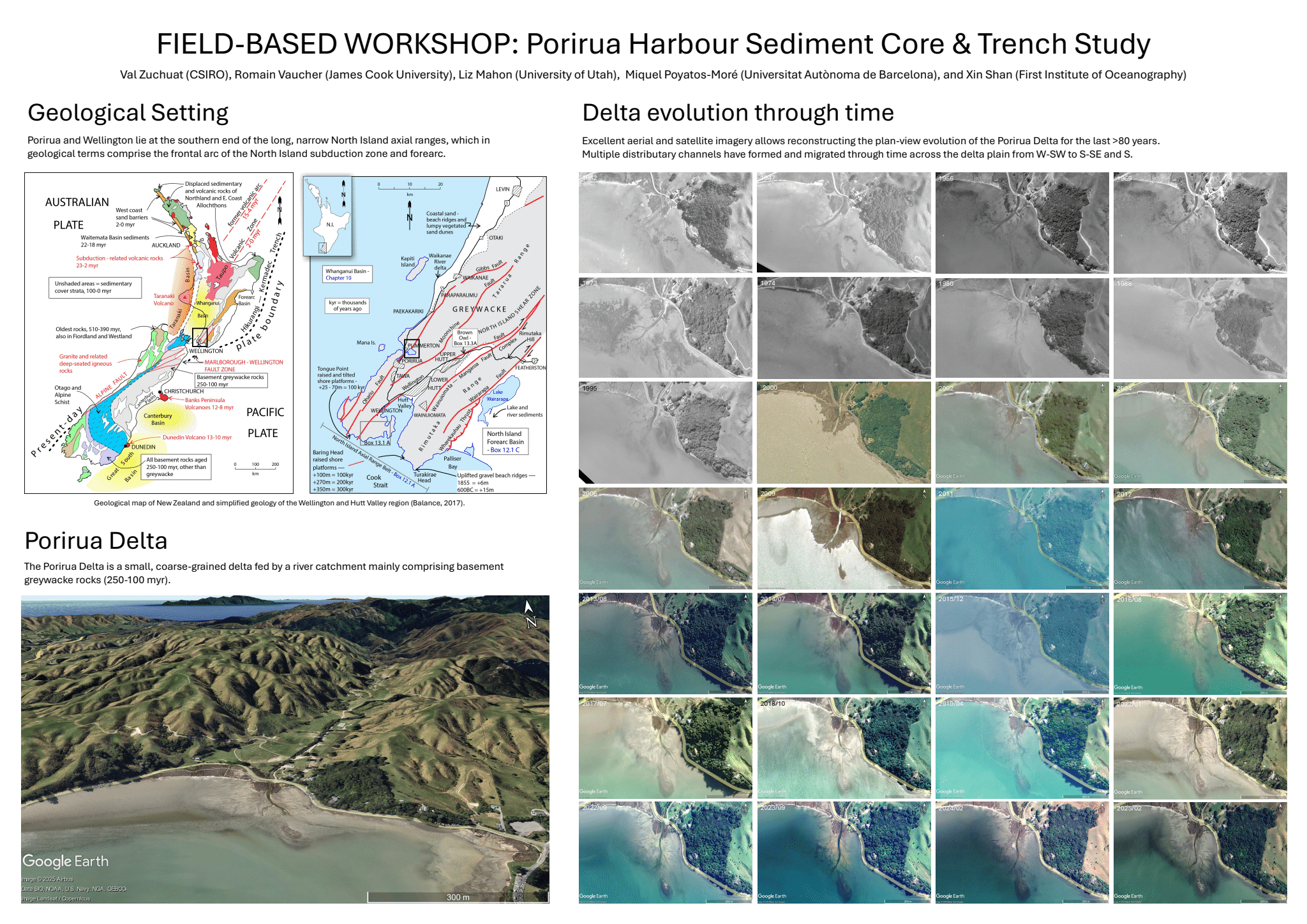
On Wednesday 28th January 2026, members of the SEPM Coast and Shelf Research Group organized a one-day field workshop for the 2026 International Sedimentological Congress in Wellington, Aotearoa New Zealand. The group comprised 25 very curious and knowledgeable early career researchers (ECRs) from five continents, who visited the shores of Te Awarua o Porirua (Porirua Harbour), with a specific focus on the very dynamic mini-delta of the Te Kakaho River (Fig. 1). As is the case for many harbours and estuaries across Aotearoa New Zealand, sedimentation remains an ongoing management challenge. This workshop served two opportunities: 1) Introduce ECRs to basic field methods used to study modern depositional systems; and 2) place the recent evolution of Te Kakaho minidelta in its historical context associated with deforestation and earthquake-related uplift. |
|
Coast and Shelf Research Group Organizers: Sonia Campos-Soto Complutense University of Madrid, Spain, (sonia.campos.soto@ucm.es) Marta Cosma National Research Council, Italy (marta.cosma@igg.cnr.it) - Carolyn Furlong MacEwan Univeristy, furlongc2@macewan.ca
Marcello Gugliotta MLU Halle-Wittenberg, Germany, marcello.gugliotta@geo.uni-halle.de) Liz Mahon University of Utah, USA (liz.mahon@utah.edu) Miquel Poyatos-Moré Universitat Autònoma de Barcelona, Spain (Miquel.Poyatos@uab.cat) Piret Plink-Björklund Colorado School of Mines, USA (pplink@mines.edu) Agustin Argüello Scotti University of Bergen, Norway (agustin.scotti@uib.no) Xin Shan First Institute of Oceanography, China (xshan@fio.org.cn) Romain Vaucher University of Geneva, Switzerland (romain.vaucher@unige.ch) Anna van Yperen University of Oslo, Norway (a.v.yperen@geo.uio.no) - Valentin Zuchuat CSIRO, Australia (val.zuchuat@csiro.au)
|